
However, the Declaration never addresses women nor slaves. By "man", the Assembly certainly did not mean "mankind", but rather the literal sense.
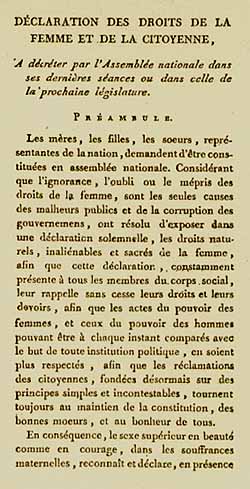
Reacting against the glaring omission of women in the Declaration, Olympe de Gouges, a pioneering feminist along with British Mary Wollstonecraft, issued a parallel declaration, called the Declaration of the Rights of Woman and the Female Citizen. (The need for "female" before the citizen comes from the French differentiation between the masculine citoyen and feminine citoyenne: the former was used by the Assembly to denote specifically a male citizen.)
De Gouges paraphrased most the words from the Assembly's version, parody-like in its point-for-point imitation, inserting "woman" where the Assembly said "man". For example:
Assembly: “Men are born and remain free and equal in rights. Social distinctions may be based only on common utility.”
De Gouges: “Woman is born free and remains equal to man in rights. Social distinctions may only be based on common utility”.
This pamphlet was dedicated, ironically enough, to Queen Marie Antoinette.


No comments:
Post a Comment