Thursday, January 21, 2010

Napoleon: Russian Reject


Anna & Napoleon: Not to be


Napoleon Bonaparte, the famously ambitious egoiste of the early nineteenth century, married his lover Josephine de Beauharnais early on in his meteoric rise, and loved her dearly. However, as Josephine turned forty-six with no sign of any children forthcoming, Napoleon’s dynastic ambitions and his desire for a royal marriage led him to divorce Josephine. He did, however, value her opinion throughout the rest of his life. In the meantime, as part of his spoils of victory against the Austrians, Napoleon married 18-year old Marie Louise…
…but not before he proposed marriage to the sister of Russian Tsar Alexander, Grand Duchess Anna Pavlovna. Unfortunately for the macho Napoleon, he was politely rebuffed.


Rejected!


Wednesday, January 20, 2010

The Empty Cradle


When official court painter Élisabeth Vigée-Le Brun painted this 1787, two years before the French Revolution erupted in full force, her intention was to show Queen Marie Antoinette as a motherly, well-respcted model lady, surrounded by her docile and equally-lovely children: her eldest daughter Marie Thérèse (Madame Royale) gazes up adoringly at her mother; youngest son Louis Charles nestles in her lap; while the Dauphin Louis Joseph is seen lifting up the cover of a cradle to show... an empty bed of white sheets.
The infant meant to be shown inside the cradle was Princess Sophie Hélène Béatrice, also known as Madame Sophie. When Vigée-Le Brun began painting this portrait, Madame Sophie was almost one year old. However, Madame Sophie died before Vigée- Le Brun finished painting, and thus Louis Joseph lifts the cover off an empty cradle. 


(There's a metaphor in this story somewhere for the doomed fate of the Royal Family!)


Devastated by her loss, Marie Antoinette brushed off consolation from her brother-in-law, saying, "Don't forget that she would have been my friend."
The Dauphin  (Crown Prince) Louis Joseph died two years after this painting was completed, in the chaos of the Estates-General fiasco in 1789. 

Sunday, January 17, 2010

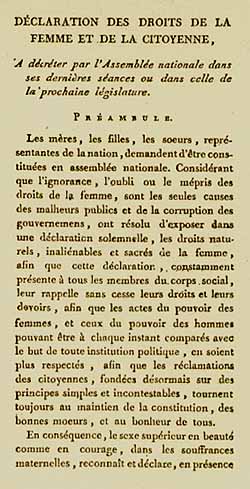
The Fairer Declaration


One of the greatest hallmarks of the French Revolution was the Declaration of the Rights of Man and of the Citizen, a document issued by the National Constituent Assembly that outlined the basic human rights that every citizen was entitled to, such as freedom of speech and press, restrictions on the power of the monarchy, and the revolutionary ideals of liberty, equality and fraternity. 
However, the Declaration never addresses women nor slaves. By "man", the Assembly certainly did not mean "mankind", but rather the literal sense.
Reacting against the glaring omission of women in the Declaration, Olympe de Gouges, a pioneering feminist along with British Mary Wollstonecraft, issued a parallel declaration, called the Declaration of the Rights of Woman and the Female Citizen. (The need for "female" before the citizen comes from the French differentiation between the masculine citoyen and feminine citoyenne: the former was used by the Assembly to denote specifically a male citizen.) 
De Gouges paraphrased most the words from the Assembly's version, parody-like in its point-for-point imitation, inserting "woman" where the Assembly said "man". For example:
Assembly: “Men are born and remain free and equal in rights. Social distinctions may be based only on common utility.”
De Gouges: “Woman is born free and remains equal to man in rights. Social distinctions may only be based on common utility”.
This pamphlet was dedicated, ironically enough, to Queen Marie Antoinette. 


A Beautiful, Blank Face: Cleopatra

As one of history's most famous faces, Cleopatra has often been depicted as dark-haired, fair-skinned woman with a perfect face. However, new research shows that according to a rediscovered and well-preserved coin, Cleopatra had a rather plainer profile than Hollywood and Audrey Hepburn will have us believe: she had a larger than average nose and a sharp, hooked nose. 


Yet one of the most intriguing mysteries about Cleopatra is not how nobody noticed her wrapped up in a rug, but her hair and skin colour: coins can't tell us that, because they weren't struck in colour. Her lineage, as a descendant of Ptolemy, general of Alexander the Great, tells us that she is a Macedonian Greek, and should be fairly light-skinned. Even though the Ptolemaic dynasty were rather xenophobic and mainly intermarried, Cleopatra may not have been a full-blooded Macedonian Greek, lending her the possibility of being part African, and thus having a darker skin colour. Her father, Ptolemy Auletes, had a Greek father but an unknown concubine for a mother. If this mistress was not Greco-Macedonian, Cleopatra might have looked much different that the stereotype dark-haired white beauty. Some supporters of that theory point to Shakespeare's "Anthony and Cleopatra", where Cleopatra is referred to as "tawny". Certain Roman chroniclers, on the other hand, suggest that she was a redhead, with a big nose; rather like Boudicca, except more of a maneater. 


Stingy Pharaohs: Gold like Dirt—but not for you!


Ancient Egyptian pharaohs allowed their sons to bring in foreign princesses and marry them, but never allowed their own daughters to leave Egypt and marry a foreigner. Even Cleopatra, the famous last queen of Egypt, never permanently left her country nor married a foreigner, since Julius Caesar and Mark Antony were only lovers, never official husbands. This (along with intermarrying) helped Ancient Egypt to remain one of the most unchanging and conservative empires in history, which is especially incredible considering its breadth in timemore than 3000 years!
Furthermore, pharaohs were extremely stingy with their gold, which was relatively plentiful in Egypt due to the rich mines in Upper Egypt .When Tushratta, a Mitannian (Mesopotamian) king wrote a letter to the pharaoh's mother, he complained that he had not received the gifts promised to him earlier by the pharaoh's father. Tushratta wrote,
 "I had asked your husband for statues of solid cast gold. . . . But now . . . your son has [sent me] plated statues of wood. With gold being dirt in your son's country, why have they been a source of such distress to your son that he has not given them to me? . . . Is this love?" 
Tushratta never got the gold, even if it was dirt to the Pharaoh. Apparently, it wasn't love.